Key Takeaways
- The 1 October 2026 surcharge changes do not make cards obsolete; they make the economics of accepting cards more visible to merchants that currently recover those costs separately.
- PayTo and cards solve different customer and operational needs, so a mixed payment strategy can be more practical than replacing one rail with another.
- Cards remain strong for familiarity, ecommerce acceptance and digital-wallet journeys.
- PayTo can be useful for account-to-account payments where customer authorisation, payment status and reconciliation information are important.
- Compare total operating cost, not only the visible transaction fee.
Why compare PayTo and cards now?
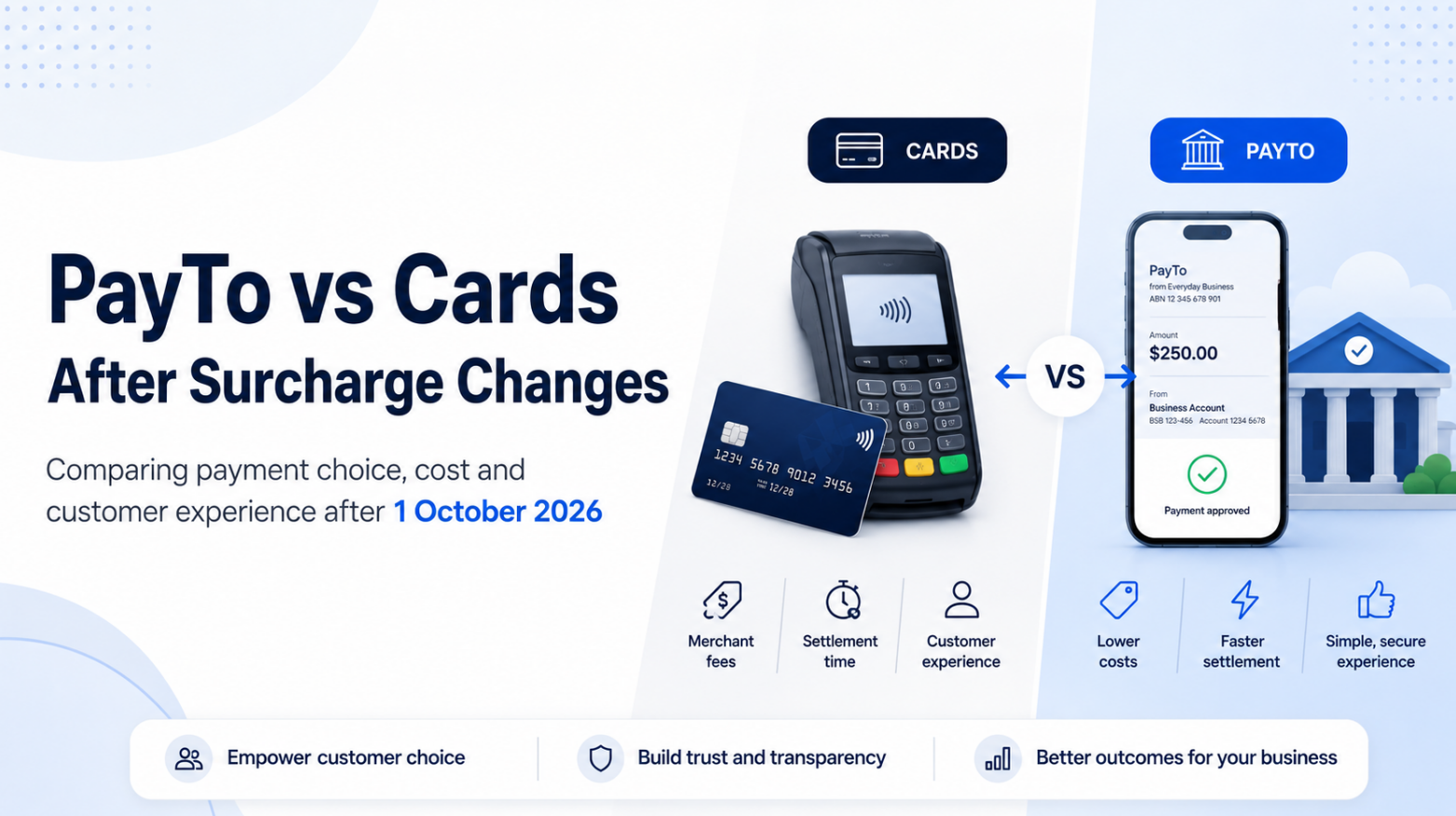
From 1 October 2026, eftpos, Mastercard and Visa have announced no-surcharge rules for card payments, while American Express has announced that it will also remove surcharging from that date. The Reserve Bank of Australia is pairing the change with lower interchange caps and additional transparency measures intended to help businesses understand card-payment costs.
For businesses that currently recover card costs through a surcharge, this creates a commercial decision: absorb the cost, adjust advertised prices, negotiate provider terms or reconsider the payment mix. See our complete small-business guide to the 1 October surcharge changes and ShaBaas Pay's member analysis published by FinTech Australia.
Where cards remain strong
Cards remain deeply embedded in Australian ecommerce and point-of-sale behaviour. They are familiar to customers, work across a broad range of merchants and support established digital-wallet journeys. For many businesses, maintaining card acceptance will remain important after 1 October.
The change is therefore not a reason to remove cards automatically. It is a reason to understand the actual cost of card acceptance and decide which customer journeys justify that cost.
Where PayTo may fit
PayTo is an account-to-account payment service on Australia's New Payments Platform. Australian Payments Plus describes PayTo as supporting one-off, ad hoc and regular payments directly from a customer's bank account, with customer authorisation through online banking and real-time payment notifications.
For businesses, PayTo can be relevant to invoice payments, repeat collections, payment links, hosted checkout and software-integrated payment workflows. Structured payment information can also support reconciliation and payment-status visibility.
Compare total cost, not headline price
Card acceptance costs can include merchant service fees, scheme fees, gateway charges, terminal costs and other provider fees. PayTo pricing depends on the provider and commercial model used. A useful comparison should therefore use the actual all-in cost of each method rather than a generic market rate.
Also include operational costs such as failed payments, support effort, settlement timing and reconciliation. For a practical worksheet, use our card surcharge cost impact guide.
Customer experience
Cards are highly familiar and can provide a fast checkout journey, particularly when a customer's card or digital wallet is already stored. PayTo uses a different approval model: customers authorise a PayTo agreement through their bank, giving them visibility and control over the arrangement.
The better method depends on the customer journey. A low-friction retail purchase may favour cards, while an invoice, account-based relationship or repeat authorised collection may be suitable for PayTo.
Settlement and reconciliation
Businesses should compare when funds become available, what transaction references are returned and how easily payments can be matched back to customers, invoices or orders. These workflow costs matter because manual reconciliation and payment chasing can consume staff time even when the visible transaction fee looks low.
PayTo can provide payment-status information and structured references that can support reconciliation. Card workflows can also reconcile effectively when merchant systems, gateways and accounting integrations are configured well. The key is to evaluate the complete workflow rather than assume one rail is automatically superior.
A practical payment-mix decision framework
- Customer preference: which methods are customers most willing to complete?
- Transaction value: how does the fee structure behave as payment value increases?
- Payment frequency: is the payment one-off, ad hoc or recurring?
- Payment certainty: how are authorisation, failure and payment status handled?
- Settlement: when does the business receive usable funds?
- Reconciliation: how much manual effort is required to match the payment?
- Refunds and disputes: what operational process is required after payment?
- Total cost: what does the complete workflow cost, including support and administration?
Where a mixed strategy can make sense
An ecommerce business may continue offering cards and wallets for immediate consumer checkout while also offering account-to-account payments for higher-value invoices or repeat customers. A professional-services business may use PayTo or PayID for invoices while keeping cards available where customers value card convenience. A subscription or account-based service may assess PayTo for authorised repeat collections while retaining cards as an alternative.
The objective is not to steer every transaction to the lowest nominal fee. It is to build a payment mix that balances customer completion, cost, cash flow and operational efficiency.
What to do before 1 October
- Calculate your actual card acceptance cost from recent merchant statements.
- Ask your card provider how its pricing and surcharge functionality will change on 1 October.
- Identify customer journeys where a bank-payment option could be tested without reducing conversion.
- Compare settlement and reconciliation outcomes, not only transaction fees.
- Update customer-facing payment choices, invoices and pricing before the transition.
Sources and further reading
See the RBA conclusions on merchant card payment costs and surcharging and Australian Payments Plus guidance on PayTo for businesses.
For broader context, compare bank payments and card payments for Australian businesses and review PayTo for small business.
Important: This guide provides general information only and is not legal, tax, accounting or financial advice. Payment-provider pricing, network rules, product capabilities and customer availability can vary.